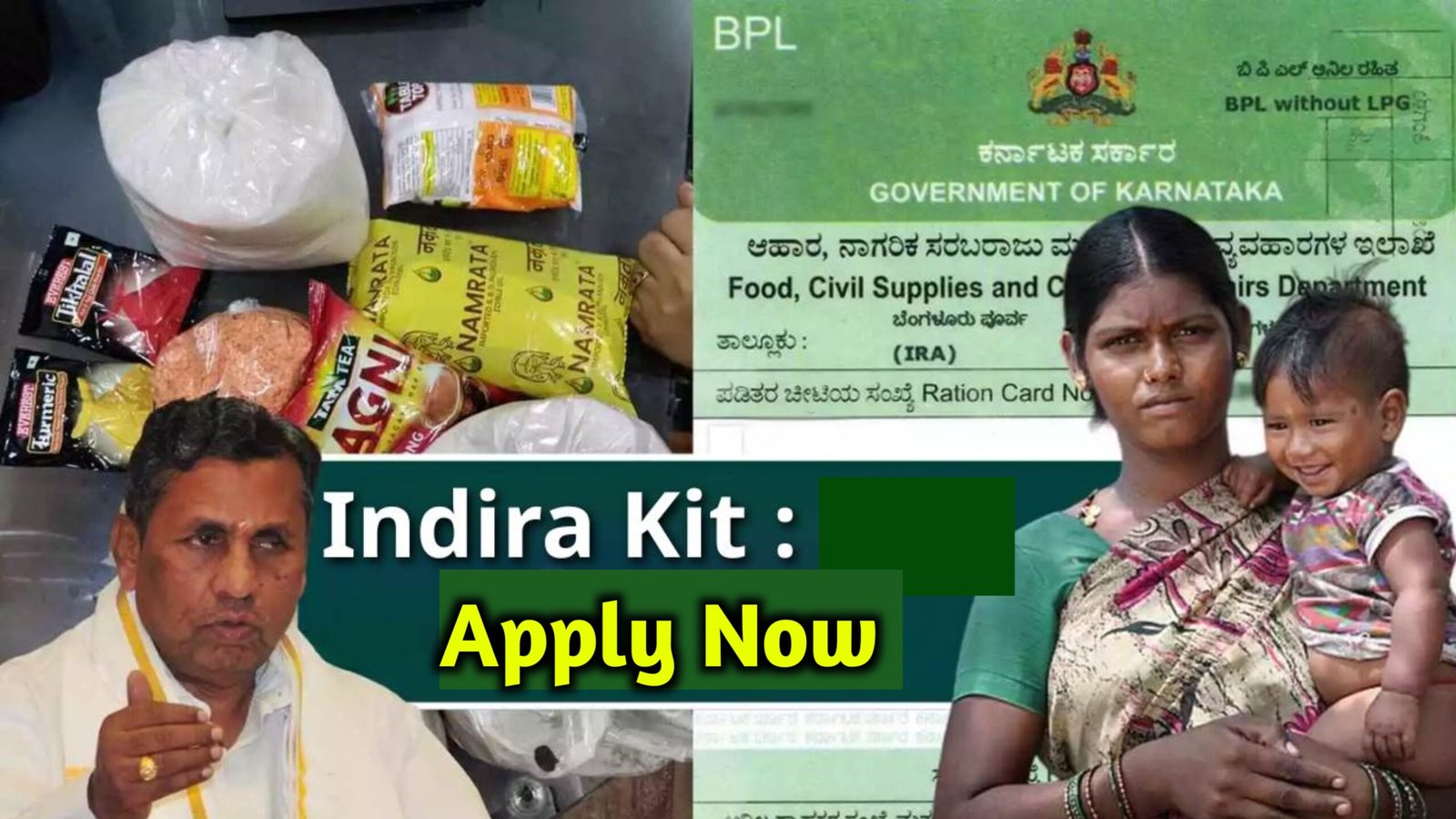
The Government of Karnataka has launched a new welfare initiative called the Indira Kit Scheme aimed at providing essential household items to ration card holders across the state. This initiative is part of the government’s continued efforts to support economically weaker families and ensure that every citizen has access to basic necessities. The Indira Kit distribution is a crucial step toward improving social welfare and reducing economic disparity among low-income households in Karnataka.
In this detailed guide, we will explore the purpose, eligibility, benefits, contents of the Indira Kit, the distribution process, and how to check your eligibility and claim your kit. This comprehensive explanation will help you understand how this scheme benefits ration card holders and how you can make the most of it.
Introduction to the Indira Kit Scheme
The Indira Kit Scheme is a welfare program initiated by the Government of Karnataka under the leadership of the Chief Minister and the Department of Food, Civil Supplies, and Consumer Affairs. It aims to provide a free package of essential household items to eligible families holding BPL (Below Poverty Line) or Antyodaya Anna Yojana (AAY) ration cards.
The scheme draws inspiration from the Indira Gandhi legacy, symbolizing inclusiveness, dignity, and empowerment for all. The kit is named “Indira Kit” as a tribute to her welfare-oriented leadership that focused on poverty eradication and social justice.
This program is a continuation of Karnataka’s welfare vision — “Namma Ooru, Namma Kutumba, Namma Suraksha” (Our town, our family, our safety). It targets poor and middle-class families struggling with inflation and rising daily expenses.
Objective of the Indira Kit Scheme
The primary objectives of the Indira Kit Distribution Scheme are:
- To provide essential household items to families below the poverty line.
- To reduce the economic burden of purchasing basic goods during times of inflation.
- To ensure food and domestic security for poor families.
- To promote social equity and welfare across Karnataka.
- To support women-headed households and vulnerable groups such as widows, elderly citizens, and single parents.
- To provide relief to families affected by natural calamities or economic crises.
This initiative aligns with Karnataka’s broader goal of achieving inclusive growth, ensuring that no family is left behind in the journey toward development and social welfare.
Who Will Receive the Indira Kit? (Eligibility Criteria)
The Indira Kit is not meant for everyone; it specifically targets ration card holders who belong to economically weaker sections. Below is a detailed look at the eligibility criteria:
Eligibility Conditions:
- Must be a resident of Karnataka — The applicant must be a permanent resident of Karnataka.
- Must hold a valid Ration Card — Only BPL (Below Poverty Line) and Antyodaya (AAY) cardholders are eligible.
- Priority to Women and Vulnerable Groups — Families headed by women, widows, senior citizens, or differently-abled persons will get preference.
- Income Limit — The family income should be below the state-defined poverty line.
- Not eligible for APL cardholders — Above Poverty Line (APL) cardholders are generally excluded from the scheme.
- Should not have received duplicate kits under any other government program — to prevent misuse and duplication.
What Does the Indira Kit Contain? (Complete Item List)
The Indira Kit is designed to provide relief and convenience to poor families. Each kit contains a mix of food and essential non-food household items. The list may vary slightly by district, but here’s the typical content breakdown:
Essential Food Items:
- Rice (5 kg) — High-quality rice provided under the state ration quota.
- Wheat flour (2 kg) — For households that consume chapati or roti.
- Tur dal / Toor dal (1 kg) — A protein-rich pulse used in daily meals.
- Cooking oil (1 litre) — Edible refined oil for home cooking.
- Sugar (1 kg) — For tea, coffee, and basic consumption.
- Salt (1 kg) — Iodized salt as a basic kitchen necessity.
- Tea powder (250 gm) — Included for daily consumption.
- Spices — A small quantity of turmeric and chili powder in some kits.
Essential Non-Food Items:
- Soap (Bathing and Washing soap) — To maintain hygiene.
- Toothpaste and brush — For oral hygiene.
- Sanitary napkins (for women) — Provided under the women welfare component.
- Face masks — To promote health safety.
- Detergent powder (500 gm) — For washing clothes.
- Coconut oil / Hair oil (100 ml) — For daily grooming needs.
- Small towel or napkin — Provided as an additional hygiene item.
Each kit’s total estimated value is around ₹500 to ₹800, depending on local prices and logistics. The government provides it free of cost to eligible families through the Public Distribution System (PDS).
How to Get the Indira Kit? (Distribution Process)
The Karnataka government distributes the Indira Kits through a well-organized process using ration shops (fair price depots) and gram panchayat offices. Here’s how the process works:
Step-by-Step Process:
- Identification of Beneficiaries:
The Department of Food and Civil Supplies prepares a list of eligible BPL and AAY ration card holders from the PDS database. - Notification and SMS Alert:
Eligible beneficiaries receive an SMS notification on their registered mobile number, informing them about kit availability and collection date. - Distribution at Ration Shops:
Kits are distributed at fair price shops (ration depots) where beneficiaries collect their monthly rations. - Aadhaar Verification:
The beneficiary must produce their Aadhaar card and ration card for biometric authentication before receiving the kit. - Acknowledgment Receipt:
Beneficiaries sign or thumbprint a receipt confirming that they have received the Indira Kit. - Door-to-Door Distribution (for elderly or disabled):
In special cases, local authorities may deliver the kits to elderly or disabled beneficiaries at home.
Note:
Distribution timelines are announced district-wise through official government press releases, local newspapers, and the Karnataka government website.
How to Check Eligibility or Status Online
Beneficiaries can verify whether their ration card number is included in the Indira Kit beneficiary list online. Follow these steps:
Online Process:
- Visit the official website of the Karnataka Food and Civil Supplies Department:
https://ahara.kar.nic.in - Go to the “e-Services” or “Beneficiary Status” section.
- Enter your Ration Card Number (RC No.) or Aadhaar Number.
- Click on “Check Status” to see your eligibility.
- If eligible, details such as the distribution center, date, and status (received/pending) will appear on the screen.
You can also contact your local ration shop or Gram Panchayat office to confirm your eligibility and kit availability.
Benefits of the Indira Kit Scheme
The Indira Kit offers numerous benefits that go beyond simple material assistance. Let’s explore the major advantages:
1. Relief to Poor Families
The kit provides essential items free of cost, helping poor families reduce daily expenses.
2. Women’s Empowerment
Since most household purchases are managed by women, the scheme empowers them directly by providing hygiene and domestic products.
3. Nutritional Support
The inclusion of rice, pulses, oil, and spices ensures a minimum level of nutritional security for low-income families.
4. Health and Hygiene
By including soaps, masks, and sanitary products, the scheme promotes hygiene and disease prevention, especially post-pandemic.
5. Inflation Relief
In times of rising commodity prices, the Indira Kit acts as a protective cushion for poor households.
6. Government Transparency
The digital verification and Aadhaar-linked distribution prevent fraud and ensure genuine beneficiaries receive the kits.
7. Social Welfare and Dignity
The scheme ensures that even the poorest families can live with dignity, without struggling for daily essentials.
Implementation and Monitoring
To ensure transparency, the government has established a strict monitoring mechanism for the Indira Kit distribution. Key aspects include:
- District-level committees supervised by Deputy Commissioners.
- Real-time digital tracking of kit distribution using PDS software.
- Third-party audits and random inspections to prevent misuse.
- Public grievance redressal system for complaints regarding non-receipt or corruption.
Citizens can lodge complaints on the Ahara helpline (1967) or email through the department’s website.
Indira Kit and Other Karnataka Welfare Schemes
The Indira Kit scheme complements other Karnataka welfare programs such as:
- Gruha Lakshmi Scheme – Monthly ₹2,000 support for women heads of families.
- Anna Bhagya Yojana – Free rice distribution to BPL families.
- Yuva Nidhi Scheme – Unemployment allowance for youth.
- Ksheera Bhagya Scheme – Free milk distribution to students.
- Shakti Scheme – Free bus travel for women in Karnataka.
Together, these schemes create a social welfare ecosystem ensuring that citizens get food, financial, and transport support to live dignified lives.
Challenges in Implementation
Despite its noble goals, the scheme faces certain challenges:
- Logistical delays in kit delivery in remote areas.
- Duplicate ration cards leading to confusion in eligibility.
- Limited awareness among rural citizens about collection dates.
- Data errors in Aadhaar linking causing authentication failures.
- Storage and transport costs that burden local administrations.
However, the Karnataka government has taken active steps to overcome these issues by improving digital records, enhancing logistics, and increasing public communication.
How to File a Complaint or Grievance
If a beneficiary has not received their Indira Kit or faces issues, they can raise complaints through multiple channels:
1. Helpline Number:
1967 – Karnataka Food and Civil Supplies Department helpline.
2. Online Complaint Form:
Visit https://ahara.kar.nic.in → “Public Grievance” → Fill complaint details.
3. In-person:
Visit your Taluk Food Office or Gram Panchayat with your ration card and Aadhaar card for verification.
Future Outlook and Government Plans
The government plans to expand the Indira Kit distribution to include seasonal or festival-specific kits (for example, Deepavali kits or Sankranti kits) in the future. It may also consider digital coupons or direct benefit transfer (DBT) options, allowing families to choose preferred items from authorized stores.
This scheme also sets a model for other Indian states to replicate similar welfare kits to help the poor manage daily living costs effectively.
- Scheme Name: Indira Kit Distribution Scheme
- Launched by: Government of Karnataka
- Beneficiaries: BPL and AAY ration card holders
- Objective: To provide essential food and non-food items free of cost
- Distribution Mode: Through ration shops and gram panchayats
- Verification: Aadhaar-based biometric verification
- Official Website: https://ahara.kar.nic.in
- Helpline: 1967
The Indira Kit Scheme is a thoughtful and impactful welfare measure by the Government of Karnataka that prioritizes the well-being of its citizens, especially those struggling financially. By providing essential household goods free of cost, the state ensures that even the most marginalized families can live with dignity, security, and comfort.
In a time when inflation and living costs are increasing rapidly, initiatives like the Indira Kit stand as a symbol of government accountability and compassion. It not only fulfills immediate needs but also strengthens public trust in welfare governance.
If you or your family holds a BPL or Antyodaya ration card, make sure to verify your eligibility and collect your Indira Kit from the nearest ration shop. This small package carries a big message — no family in Karnataka should go without essentials.
Important Links
- Official Website: https://ahara.kar.nic.in
- Helpline Number: 1967
- Department: Food, Civil Supplies & Consumer Affairs, Karnataka
- For Updates: Follow Karnataka Government’s official Twitter and District Collector pages for announcements.