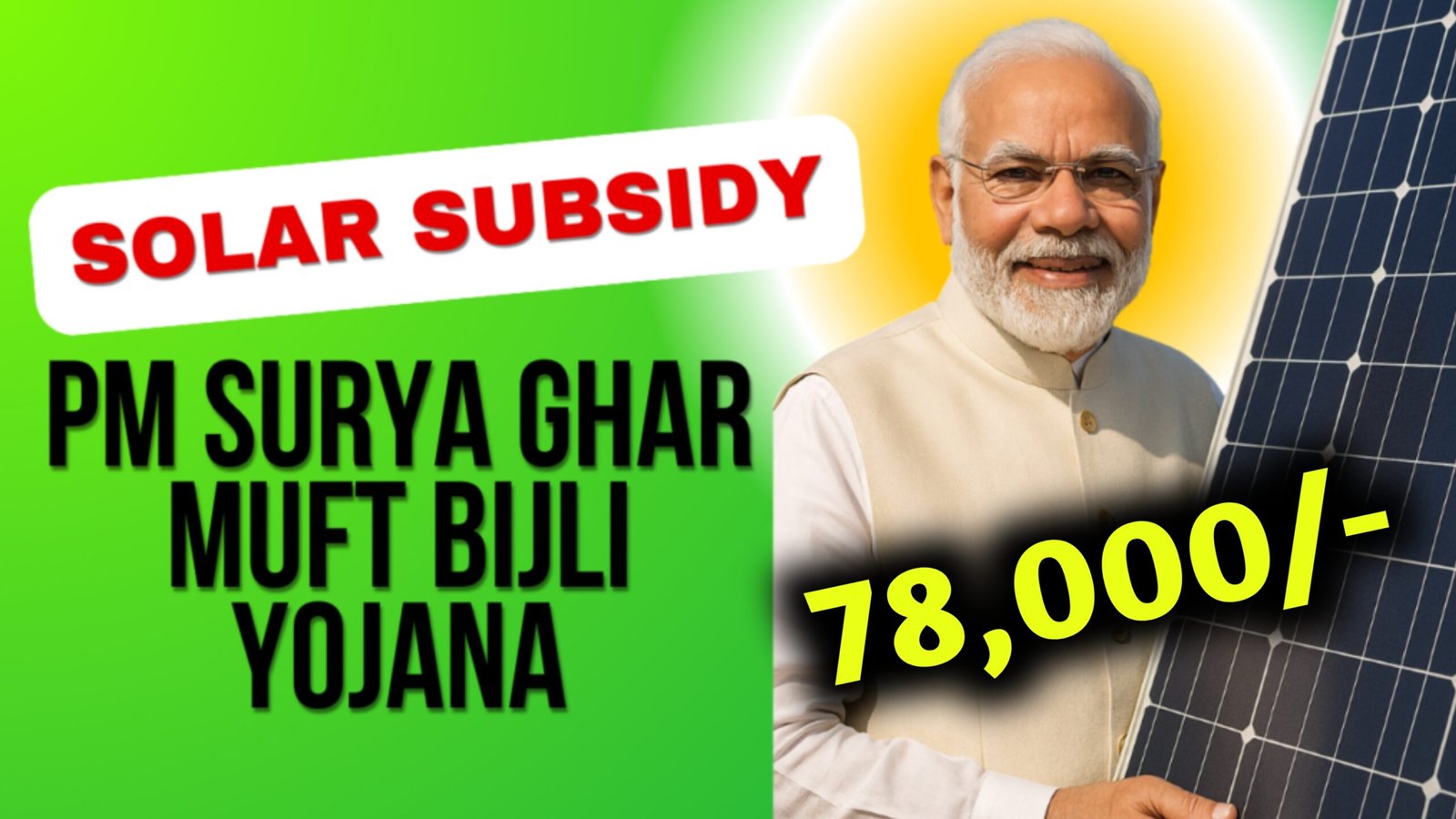
New Delhi | September 30, 2025 — In a major push toward clean energy and financial savings for Indian households, the Government of India has rolled out the PM Surya Ghar: Muft Bijli Yojana, a flagship initiative aimed at promoting solar rooftop installations across the country.
This ambitious scheme promises up to ₹78,000 subsidy and 300 units of free electricity every month for families who own their own homes.
The programme has already generated massive public interest, with lakhs of homeowners registering on the official portal. Here’s a complete, detailed look at the benefits, eligibility, application process, required documents, subsidy structure, and how this scheme is expected to transform household energy consumption across India.
1. Scheme Overview: PM Surya Ghar Muft Bijli Yojana
The PM Surya Ghar: Muft Bijli Yojana was launched by Prime Minister Narendra Modi in early 2024. The primary goal of the scheme is to encourage rooftop solar adoption by providing heavy subsidies and making installation simple, affordable, and financially beneficial for ordinary families.
Key objectives include:
- Promoting renewable energy to reduce dependence on coal
- ✅ Empowering households to generate their own electricity
- Reducing monthly electricity bills
- Achieving India’s net zero carbon emission goals
- Making electricity affordable for lower and middle-income families
The scheme covers residential buildings only — it is meant for people who own their homes and have a proper rooftop structure suitable for solar panel installation.
2. Key Benefits of the Scheme
The PM Surya Ghar Yojana provides a combination of financial subsidies and free power generation, making it one of the most attractive government programmes in recent years.
Here are the major benefits:
2.1. Up to ₹78,000 Subsidy
Homeowners can receive direct subsidy support of up to ₹78,000 from the Central Government. The subsidy is credited directly to the beneficiary’s bank account after successful installation and inspection of the solar rooftop system.
2.2. 300 Units of Free Electricity Per Month
The electricity generated by rooftop solar panels is used for the household’s daily consumption. If the system produces 300 units per month, the family may not need to pay any electricity bill at all. In some cases, surplus power can even be sent back to the grid, further lowering costs.
2.3. Zero Fuel Cost & Low Maintenance
Once installed, solar panels require minimal maintenance. There is no recurring fuel cost, unlike diesel generators or traditional power sources.
2.4. Increased Property Value
Houses equipped with rooftop solar systems often experience higher resale values, as future buyers appreciate reduced electricity costs and sustainable infrastructure.
2.5. Environmental Impact
A 3 kW rooftop solar system reduces approximately 4 tons of carbon dioxide emissions annually — equivalent to planting more than 100 trees per year.
3. Eligibility Criteria
Not everyone qualifies automatically for this scheme. To maintain transparency and ensure the subsidy reaches deserving households, the government has set the following eligibility conditions:
- The applicant must be an Indian resident.
- The applicant must own the house and the rooftop where the solar panels will be installed.
- The roof must have adequate space and strength for installation.
- The electricity connection must be domestic/residential.
- The applicant should not have availed of similar solar subsidies earlier.
- A valid electricity connection and no outstanding bills are required.
- The installation must be done through authorised vendors listed on the official portal.
4. Subsidy Structure — How ₹78,000 Is Calculated
The subsidy amount depends on the capacity of the solar plant being installed. Below is the government’s approved subsidy structure for 2025:
| Solar System Capacity | Subsidy Amount |
|---|---|
| Up to 2 kW | ₹30,000 per kW |
| 3 kW | ₹78,000 total |
| Above 3 kW | ₹78,000 (fixed maximum) |
For example:
- If a homeowner installs a 2 kW system, the subsidy is ₹60,000.
- For a 3 kW system, it’s ₹78,000.
- For systems larger than 3 kW, the subsidy remains capped at ₹78,000, but homeowners may benefit from greater free power generation.
This structure ensures maximum support for small to medium households, where a 2–3 kW solar system is usually sufficient for daily needs.
5. Step-by-Step Application Process
Applying for the PM Surya Ghar Scheme is 100% online and designed to be simple and transparent. Here’s how it works:
Step 1: Visit the Official Portal
Go to https://pmsuryaghar.gov.in and register using your mobile number and electricity connection number.
Step 2: Choose Your DISCOM & Vendor
Select your local electricity distribution company (DISCOM) and choose an authorised solar vendor from the list.
Step 3: Submit Application
Fill in the required details including property ownership, rooftop size, and proposed capacity of the solar plant. Upload identity and property documents.
Step 4: Technical Feasibility Approval
The DISCOM will verify whether your rooftop is suitable and issue a technical feasibility approval.
Step 5: Installation of Solar System
The selected vendor installs the solar system. You do not have to pay the full cost upfront; the subsidy is adjusted.
Step 6: Net Metering & Inspection
After installation, net meters are set up to measure solar generation and grid export. Officials conduct a final inspection.
Step 7: Subsidy Release
Once the inspection is approved, the subsidy amount is directly credited to your bank account within a few weeks.
6. Documents Required
Applicants need to keep the following documents ready while applying:
- Aadhaar Card
- Recent electricity bill
- Property ownership proof (e.g., tax receipt or sale deed)
- Bank account details for subsidy transfer
- Passport-size photograph
- Email ID and mobile number
All documents must be clear and uploaded in the required formats to avoid delays.
7. How Free Electricity Works
The promise of 300 units of free electricity is not a direct cash transfer. Instead, it works through solar power generation and net metering:
- The rooftop solar system generates electricity during the day.
- This power is first used to run household appliances.
- If excess power is produced, it flows back into the grid.
- At night or on cloudy days, the household draws power from the grid.
- The net meter calculates the balance, and in many cases, the electricity bill drops to zero.
In states like Karnataka, this can be combined with state schemes such as Gruha Jyothi, which provides 200 free units — resulting in even bigger savings.
8. Important Deadlines & Targets
The Central Government has set ambitious targets under this scheme:
- Application Deadline: Currently, there is no fixed last date, but homeowners are encouraged to apply early as subsidies are allocated on a first-come, first-served basis.
- Target: Install rooftop solar systems on 1 crore households by 2027.
- Capacity Target: Achieve 40 GW rooftop solar capacity nationwide.
Given the scale, DISCOMs and vendors are working at full speed to process applications quickly.
9. Official Website & Helpline
- Official Website: https://pmsuryaghar.gov.in
- Helpline Number: 1800-xxx-xxxx (Toll-Free)
- Email: support@pmsuryaghar.gov.in
- State Nodal Agencies: Each state has dedicated renewable energy departments coordinating implementation.
Applicants should only use the official portal and authorised vendors to avoid fraud.
10. Expert Opinions & Economic Impact
Experts believe this scheme could be a game changer for India’s energy landscape:
“The rooftop solar subsidy scheme not only makes renewable energy affordable for ordinary citizens but also reduces the burden on the national power grid,” said Dr. Anil Sharma, Energy Policy Analyst at TERI.
Financial analysts point out that installing a 3 kW solar system typically costs around ₹1.5 lakh. With a ₹78,000 subsidy, the effective cost drops by more than 50%, and families recover the investment within 3–4 years through savings on power bills.
Moreover, large-scale rooftop solar adoption will:
- Reduce peak load demand
- Lower greenhouse gas emissions
- Generate new employment in the solar installation sector
- Improve energy security for the country
11. Conclusion: A Win-Win for Homeowners and the Nation
The PM Surya Ghar Muft Bijli Yojana represents a historic opportunity for homeowners to save money, gain energy independence, and contribute to a greener future.
With subsidies of up to ₹78,000 and 300 units of free power per month, households can drastically cut their electricity bills while enjoying reliable power supply.
Homeowners who have not yet applied are advised to visit the official website immediately, check their eligibility, and start the online application to secure their subsidy before allocations fill up.
- Scheme: PM Surya Ghar Muft Bijli Yojana
- Subsidy: Up to ₹78,000
- Free Power: 300 units/month
- Portal: pmsuryaghar.gov.in
- Who Can Apply: Homeowners with residential rooftop space
In Summary:
The combination of financial incentives, environmental benefits, and long-term savings makes this scheme one of the most powerful steps toward achieving India’s renewable energy goals while directly benefiting common citizens.
As more households join the solar revolution, India moves closer to becoming a clean energy powerhouse, and families enjoy free electricity for years to come.